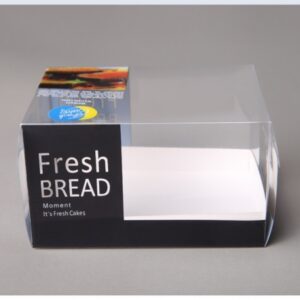
- Primary keyword: food blister packaging
- Secondary keywords: blister tray, thermoformed tray, vacuum-formed tray, PET clamshell, hinged packaging, food packaging box manufacturer, custom blister packaging, food-grade plastic tray, bakery packaging, cake takeout box
1. Why Food Blister Packaging Is Everywhere in Modern Food Retail
Walk into any bakery shop, patisserie, dessert café or supermarket bakery, and you will see the same story: pastries, cakes, macarons and desserts sitting inside crystal-clear plastic boxes that let customers see exactly what they are buying.
That box is a food blister pack — a thermoformed (vacuum-formed) plastic package shaped around the product. Unlike printed paper boxes that hide the contents, blister packaging makes the product itself the packaging design. The transparent dome shows off frosting, glaze and decoration, while the rigid structure protects fragile items in transit.
For bakeries, dessert brands and takeaway food businesses, this combination of see-through display + crush-resistant protection is why blister packaging has become one of the most popular choices in disposable food packaging — and why food packaging box manufacturers receive more inquiries for it every year.
This guide explains what food blister packaging is, which materials and structures fit which products, how customization works, and how to choose a reliable supplier for bulk orders.
2. What Is Food Blister Packaging? Key Terms Explained
Food blister packaging (also called blister pack, blister tray, plastic blister, thermoformed tray or vacuum-formed tray) is made by heating a flat plastic sheet and forming it over a mold — a process called thermoforming, or vacuum forming when air is pulled out to draw the sheet onto the mold.
The result is a thin-walled, rigid package that mirrors the shape of the food inside: a cake carrier with a tall dome for layer cakes, a low food tray for cookies, a multi-compartment tray for bento-style lunches, or a snap-lock blister box for takeaway desserts.
Common industry terms you will meet:
| Term | What it means | Typical use |
|---|---|---|
| Blister tray / thermoformed tray | Open or lidded formed tray | Cookies, pastries, fruits, sliced cake |
| Clamshell / hinged packaging | One-piece box with a built-in hinge, no separate lid needed | Cupcakes, donuts, muffins, sandwiches |
| Snap-lock blister box | Clamshell with locking tabs that close firmly | Takeaway desserts, premium pastries |
| Plastic insert / inner tray | Formed insert placed inside an outer box | Gifting sets, cake boxes with dividers |
| Multi-compartment tray | Tray divided into 2 or 3 sections | Meal boxes, dessert assortments |
| Skin packaging | Product sealed tightly under a thin film | Charcuterie, fresh meat, seafood |
Because most blister boxes are produced as a single onepiece hinged box, they save warehouse space (flat stacking before filling), reduce assembly time at the bakery counter, and lower packaging cost per unit compared with lid-and-base two-piece systems.
3. Product Types: Matching the Package to the Food
3.1 Cake and pastry boxes (cake box, pastry box, dessert box)
Tall hinged containers with crystal-clear domes protect layer cakes, cream cakes and birthday cakes without touching the frosting. Anti-fog options keep the view clear when cakes move from cold storage to the counter. Sizes range from single-slice cake takeout boxes to full-size carriers for 6–16 inch cakes.
3.2 Cupcake, macaron and cookie boxes (cupcake box, macaron box, cookie box)
Low-profile trays with individual cavities keep cupcakes and macarons separated — no smudged frosting, no broken shells. Donut boxes and croissant boxes follow the same logic: each item sits in its own formed pocket, so the box can be stacked in delivery bags without crushing the product.
3.3 Clamshell and snap-lock takeaway boxes
PET clamshells and snap-lock blister boxes dominate takeaway: one piece, one motion to close, secure enough for courier delivery. The hinged lid doubles as a display window on the shelf, and the stackable design means clean storage behind the counter.
3.4 Multi-compartment and divided trays (compartment box, divided tray)
For lunch boxes, dessert assortments and catering, 2-compartment and 3-compartment trays portion each item in its own cell — sauces stay away from cakes, and savory items stay away from sweet ones. Stackable and nesting tray designs save space in both the kitchen and the delivery bag.
3.5 Plastic inserts and window boxes
For premium gifting, a plastic insert (inner tray) sits inside a rigid box or foldable box, holding macarons or chocolates in precise rows. Add a ribbon, sleeve or handle and the package becomes a ready-to-gift presentation.
3.6 Complementary paper packaging
Many bakeries pair blister boxes with paper lines: greaseproof paper and parchment paper liners, cupcake liners, bakery kraft paper bags and food paper trays for the counter, and PE-coated paper cups for drinks. A full packaging program — plastic where clarity matters, paper where breathability or compostability matters — is usually the most cost-effective strategy.
4. Materials Guide: PET, RPET, PP, PS and Food-Grade Compliance
The material determines clarity, temperature resistance, recyclability and price. Most food blister packaging is made from one of four plastics:
| Property | PET | RPET (recycled PET) | PP | PS / BOPS |
|---|---|---|---|---|
| Clarity | Crystal clear, glass-like | Clear (slightly less brilliant) | Translucent to clear | Clear |
| Rigidity / crush resistance | Excellent | Excellent | Good | Good (BOPS is tougher) |
| Heat resistance | Low–medium (cold to room temp) | Low–medium | High — microwavable, some grades oven-safe | Low — not for microwaves |
| Cold resistance | Good | Good | Excellent — freezer-safe | Limited (PS can become brittle) |
| Oil / grease resistance | Good | Good | Excellent | Good |
| Recyclability | Widely recyclable | Recycled content, recyclable | Recyclable | Recyclable in most programs |
| Typical use | Cakes, patisserie, clamshells, displays | Eco-positioned takeaway packaging | Meal trays, microwavable food boxes, freezer items | Budget trays, bakery inserts |
4.1 PET — the display champion
PET (polyethylene terephthalate) delivers the crystal-clear, high-gloss look that makes cakes and pastries irresistible. It is rigid enough to protect cream cakes in stacked delivery, and it is one of the most widely recycled plastics. PET is the default choice for cake boxes, PET clamshells and most premium display packaging.
4.2 PP — the workhorse for hot and cold
PP (polypropylene) handles heat that PET cannot: it is microwavable, performs well with hot takeaway food, and stays tough in the freezer. It also resists oil and grease, making it the standard for meal trays and reheatable food boxes. Clarity is good but not as brilliant as PET — which is why premium patisserie display still favors PET.
4.3 PS and BOPS — the value option
PS (polystyrene) is economical and rigid, and BOPS (biaxially oriented PS) adds toughness. It suits budget bakery inserts and short-shelf-life items, but has low heat resistance and can be brittle in the cold, so it is rarely used for freezer or microwave lines.
4.4 Food-grade safety requirements
Whatever the polymer, food-contact packaging must be food-grade. Reputable suppliers hold certifications covering FDA food contact (US), EU 10/2011 (European food-contact plastics regulation), LFGB (Germany) and BRC where required, and operate under ISO 9001 quality management. Materials should be BPA-free, odorless and non-toxic, and every production batch should be traceable to its resin.
Always ask your supplier which resin grade is used and which food-contact certificates apply to your destination market — compliance is a requirement, not a selling point.
5. Features That Matter: Selling Points for Blister Packaging
5.1 See-through appeal (transparent, crystal clear, see-through)
Transparent packaging lets the product sell itself. A clear lid over a decorated cake, or a see-through clamshell around a colorful cupcake, increases counter impulse purchase — shoppers buy what they can see.
5.2 Anti-fog coating
When warm pastries meet a cool box — or chilled desserts hit a warm counter — condensation fogs the lid and hides the product. An anti-fog coating keeps the view clear across temperature changes, essential for cream cakes and chilled desserts.
5.3 Crush-resistant protection (crush-resistant, rigid)
Blister walls absorb impact. A rigid, crush-resistant dome keeps frosting untouched and macaron shells intact through stacking, bagging and courier delivery — the #1 reason bakeries switch from flimsy paper boxes to thermoformed trays.
5.4 Stackable and nestable design (stackable, nestable, space-saving)
Stackable boxes lock together stably for counter display and delivery; nesting trays taper so empty trays take minimal space in storage and transport — directly reducing shipping volume.
5.5 Leak and grease control (leak-proof, greaseproof, oil-resistant)
Snap-close and hinged designs with tight seals are leak-resistant for saucy takeaway food, while greaseproof and oil-resistant materials (especially PP) handle butter-heavy pastries without staining or softening.
5.6 Tamper-evident and resealable options
Snap-close lids that audibly lock, tamper-evident seals and resealable closures give both retailers and end customers confidence in freshness and safety.
5.7 Temperature versatility (microwavable, freezer-safe, oven-safe)
Depending on material: microwavable PP trays for reheating meals, freezer-safe boxes for frozen desserts and par-baked goods, and selected oven-safe grades for short reheating. Always confirm the exact temperature window with your supplier before printing claims on packs.
5.8 Premium look (elegant, premium look)
Thicker sheet, polished edges, gold hot stamping or embossing on the lid — small upgrades turn a standard clamshell into an elegant package that supports a premium price point.
6. Where Food Blister Packaging Is Used
- Bakery shop & patisserie counters — pastry display trays, cake boxes, croissant and donut boxes
- Dessert cafés & online bakeries — Instagram-friendly clear boxes that photograph well and ship well
- Wedding dessert tables & event catering — macaron trays, multi-tier dessert boxes, multi-compartment catering trays
- Supermarket bakery & hotel bakery — pre-packed pastries with clear labels, batch trays
- Takeaway & food delivery — snap-lock clamshells, 2- and 3-compartment meal boxes
- Home bakery & baking schools — retail-size packs for small-batch sellers
- Gifting — boxed cake and dessert sets with plastic inserts, ribbons and sleeves
For each channel the same question applies: will this package keep the product beautiful from counter to customer? Blister packaging answers it with structure and visibility together.
7. Customization: OEM & ODM from a Food Packaging Box Manufacturer
Most food packaging buyers do not buy off-the-shelf — they need custom size, custom logo, custom design or a full private label program. A mature blister packaging manufacturer offers the complete chain in-house.
7.1 What can be customized
- Structure — custom cavities, dividers, hinges, locking tabs, handles, window film inserts
- Size — any dimension to fit your cake range or portion program
- Surface — matte or gloss finish, printed lids (offset printing), hot stamping, embossing/debossing, lamination, window patching
- Color — clear, colored, tinted or natural color (unpigmented) sheets
- Branding — custom logo printing, private label packaging with your brand name
- Accessories — dividers, inner trays, ribbons, sleeves, gift handles
7.2 The custom process: from idea to shipping
- Inquiry & spec — share product photos, dimensions and quantity; supplier proposes materials and structure.
- Mold development — thermoforming tools are machined from your product shape; tooling cost and lead time depend on cavity count.
- Sample confirmation — pre-production samples are checked for fit, clarity and closure before mass production. Sample service is available on request.
- Bulk production — sheet extrusion, forming, die cutting, printing and assembly run under QC inspection at each stage.
- Packing & export — nesting-packed and palletized, with container loading planned to maximize volume, shipped FOB or CIF with full export documentation.
7.3 Commercial terms to know (MOQ, quotation, lead time)
- MOQ (minimum order quantity) — typically based on number of mold cavities; lower for stock sizes, higher for custom tools
- Quotation & price list — unit price scales with volume; ask for the tiered price list for bulk order planning
- Lead time — stock items ship fast; custom tooling adds 2–4 weeks on top of production
- Production capacity — check monthly output so your seasonal peaks (Valentine’s, Christmas, wedding season) are covered
Working factory direct with the manufacturer — rather than a trading intermediary — shortens communication, protects your tooling, and usually improves both price and quality control.
8. Sustainability and Certifications
Sustainability is now a purchasing criterion, not a preference. What to look for and ask about:
8.1 Recyclable plastic packaging
PET and PP blister packaging is recyclable in mainstream programs, and RPET lines let you market recycled content. Ask whether the printed lid can be separated easily — mixed-material packs are harder to recycle.
8.2 Paper and fiber alternatives
Where plastic is not required, fiber options close the loop: molded pulp and paper pulp trays, sugarcane bagasse and bamboo fiber containers, and recycled paper / FSC-certified paper for bags and cartons. These suit dry bakery items and are marketed as compostable or biodegradable where certified.
8.3 Certifications to request
- FDA food contact (US market) and EU 10/2011 (EU market), LFGB (Germany)
- BRC food packaging safety, ISO 9001 quality management
- FSC certification for paper components
- EN 13432, BPI or OK Compost certifications for compostable fiber packaging
A supplier that documents compliance across all three groups — food safety, quality and environmental claims — makes your own market entry substantially easier.
9. How to Choose a Food Blister Packaging Supplier
A quick checklist before you request a quotation:
- Factory or trader? Ask for a factory audit, machine list and photos — real manufacturers show their thermoforming lines.
- Material and compliance docs — resin grades, food-grade certificates, test reports for your market.
- Mold and customization capability — in-house tooling means faster custom samples and lower tooling cost.
- QC process — incoming resin checks, inline inspection, pre-shipment QC inspection reports.
- Export experience — global shipping lanes, packing standards, FOB/CIF terms, documentation for importers and distributors.
- Capacity and lead time — can they cover your peak season without slippage?
10. FAQ
Q: What is the difference between a blister tray and a clamshell box? A: A blister tray is usually an open or separate-lidded formed tray; a clamshell (hinged) box is one piece with an integrated lid that folds shut — faster to fill, fewer parts.
Q: Can blister packaging go in the microwave or freezer? A: It depends on the material. PP is generally microwavable and freezer-safe; PET is not for microwave or oven. Confirm the temperature window with your supplier before making claims on-pack.
Q: What is the typical MOQ for custom blister packaging? A: MOQ is driven by mold cavities and sheet size. Stock designs usually have low MOQs; fully custom tooling requires higher volumes to spread the tooling cost.
Q: Are samples available before bulk orders? A: Yes — sample support is standard practice. Request samples to test fit, clarity and closure with your actual products before committing to production.
Q: Is food blister packaging recyclable? A: PET and PP trays are recyclable in most programs, and RPET adds recycled content. Ask your supplier for material documentation to verify claims for your market.
Q: Can you print our logo on the lid? A: Yes — offset printing, hot stamping, embossing and label application are available for custom branding and private label programs.
11. Final Word: Packaging That Sells and Survives
The best packaging for food does two jobs at once: it protects the product through every hand it passes, and it makes the product look good enough to buy. Food blister packaging does both — crystal-clear visibility on the shelf, crush-resistant structure in the bag, and temperature-appropriate materials for the cold chain or the delivery rider.
Whether you run a single bakery shop or supply national chains, working with an experienced food packaging box manufacturer on custom thermoformed trays, clamshells and blister boxes turns packaging from a cost line into a brand asset.
Sunkil specializes in food blister packaging and thermoformed food trays for bakeries, patisseries and food brands worldwide — from stock designs to full OEM/ODM programs, with food-grade compliance documentation for export. [Contact us] with your product details for a quotation and sample options.